Tiny Country, Big Legends: Nauru’s Mighty Olympic Story
With a population of approximately 12,000, Nauru is the least populated member of the Olympic family, but when it comes to heart and heroics, this island has a huge story.
Its journey in sport has produced inspiring legends that transcend its size. This is the tale of how a Pacific republic carved out a place on the world’s biggest sporting stage.
From pleasant island to the Olympics
Nauru’s Olympic experience began in the early 1990s, fuelled by the dreams of a young weightlifter named Marcus Stephen. In 1994, Nauru joined the International Olympic Committee (IOC), clearing the way to send a team to the 1996 Atlanta Olympics.
Marcus Stephen had already made history by then, when at Barcelona 1992 he became Nauru’s first Olympian, competing under Samoa’s flag because Nauru hadn’t yet been recognised by the IOC. By Atlanta ’96, the Nauruan flag flew in the Olympic stadium for the first time, carried proudly by Stephen at the opening ceremony. It was a goosebumps moment! The smallest nation on earth marching among the giants. Nauru sent three lifters to Atlanta and has participated in every Summer Olympics since. To date, 13 Nauruan athletes have competed at the Games (all in weightlifting, judo, or sprinting), a humble number, but each carried the hopes of a proud nation.
The weightlifting warriors
Nauru’s Olympic efforts have centred on weightlifting, a sport where raw strength and technique meet. In fact, weightlifting is virtually a national sport (alongside Aussie Rules football). The country’s intense focus produced a golden generation of lifters who dominated regional competitions. Marcus Stephen was the trailblazer; at age 20 he burst onto the scene at the 1990 Commonwealth Games, winning gold and silver. Over the next decade he amassed seven Commonwealth Games gold medals and five silvers, becoming Nauru’s most decorated athlete.
Although an Olympic medal eluded him (he competed in ’92, ’96, and 2000), Stephen’s feats earned him hero status at home. Following in his footsteps were lifters like Quincy Detenamo, Itte Detenamo (who represented Nauru at three Olympics), Reanna Solomon, and Yukio Peter. Reanna Solomon made history as Nauru’s first female Olympian in 2004 and had earlier won two Commonwealth golds in the women’s super-heavyweight category. Yukio Peter finally struck Commonwealth gold for Nauru’s men again in 2010, lifting a combined 333 kg and prompting celebrations across the island.
They trained in humble gyms without fancy facilities, yet managed to hoist world class weights. In weightlifting circles, Nauru became known as a powerhouse per capita, producing world class lifters.
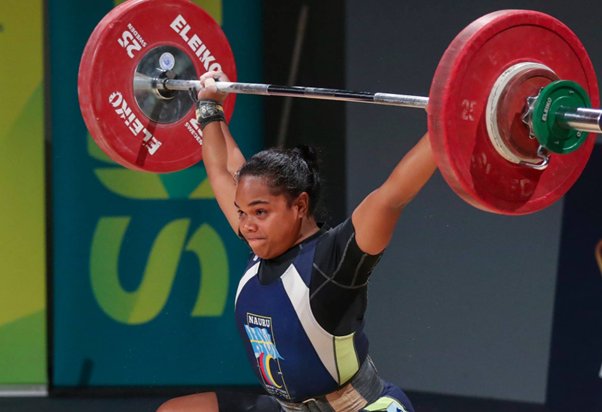
Marcus Stephen: lifting a nation’s hopes (and then leading it)
No story of Nauru’s Olympics is complete without Marcus Stephen, the legend who went from athlete to President. His Olympic debut in 1992 was unusual: since Nauru wasn’t an IOC member yet, he competed for Samoa (courtesy of a gracious arrangement with Samoa’s government).
He placed a credible 9th in his weight class, a strong showing that proved Nauruans could contend with the world’s best. By 1996, when he finally wore Nauru’s colours at the Atlanta Olympics, he was not just an athlete but a flag-bearer, carrying the identity of a new Olympic nation on his shoulders. Though injury struck in Atlanta, Stephen didn’t let it stop him. He continued to compete through the 2000 Sydney Olympics, then retired from lifting with an astounding 12 Commonwealth medals in total.
But his service to Nauru had only begun. In 2003, he was elected to Parliament, and by 2007, the champion weightlifter had become President of Nauru, serving until 2011. It is a script you might expect from a movie - hometown sports hero rises to lead his country - but in Nauru it is reality. He remains an influential figure as the current speaker of parliament and head of Nauru’s Olympic Committee. As he once humorously noted, hefting weighty legislation in Parliament can be as challenging as lifting heavy barbells!
Breaking barriers and new generations
Nauru’s Olympic journey has also been about inclusion and breaking barriers on the world stage. In Sydney 2000, Sheeva Peo made history as the first Nauruan woman to compete in the Olympics. Peo, a weightlifter, finished 10th in her class, proving that Nauruan women could compete alongside the men.
Her participation was a proud moment for the nation and paved the way for others like Reanna Solomon, who competed in Athens 2004. Over the years, Nauru has also diversified its Olympic team beyond weightlifting. In 2012, Sled Dowabobo ran the 100m sprint, and in 2016 Ovini Uera took to the judo mat, expanding Nauru’s Olympic story into new sports.
At Tokyo 2020, Nauru sent two young athletes, weightlifter Nancy Genzel Abouke and judoka Jonah Harris – symbolising a new generation carrying the torch. Nancy, just 19, even placed 10th in the women’s 76 kg weightlifting, an impressive finish that gives hope Nauru might crack the Olympic medal tally in the future.
Mighty dreams for the future
Every Olympics, when a lone Nauruan athlete walks in the Parade of Nations among the global giants, it’s a reminder of the Olympic spirit in pure form. Looking ahead, Nauru continues to invest in sports development. The island now has a high performance centre for weightlifting - in collaboration with Australia and the International Weightlifting Federation - to nurture the next generation of lifters. The government supports programs to get more youth into sports like judo, athletics, and swimming.
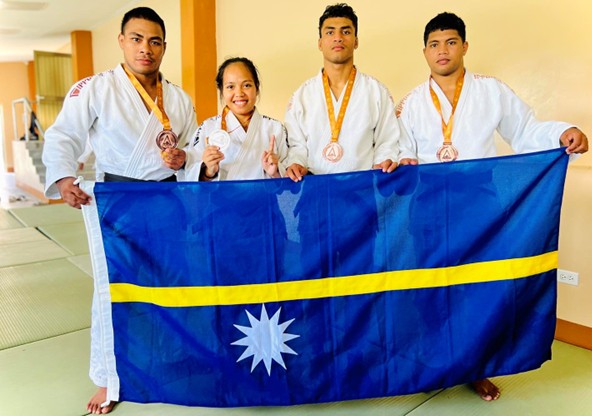
The ultimate dream? To see a Nauruan stand on an Olympic podium. Nauru’s Olympic story is the story of a “weight” that is far heavier than a barbell, that of national pride that a few brave athletes have carried for their people. It’s about an island that refuses to be invisible.
As we cheer on the superpowers in 2028 or 2032, save some applause for Nauru, the little team with a lion’s heart, still chasing that mighty Olympic dream.